The label, not just the marketing list
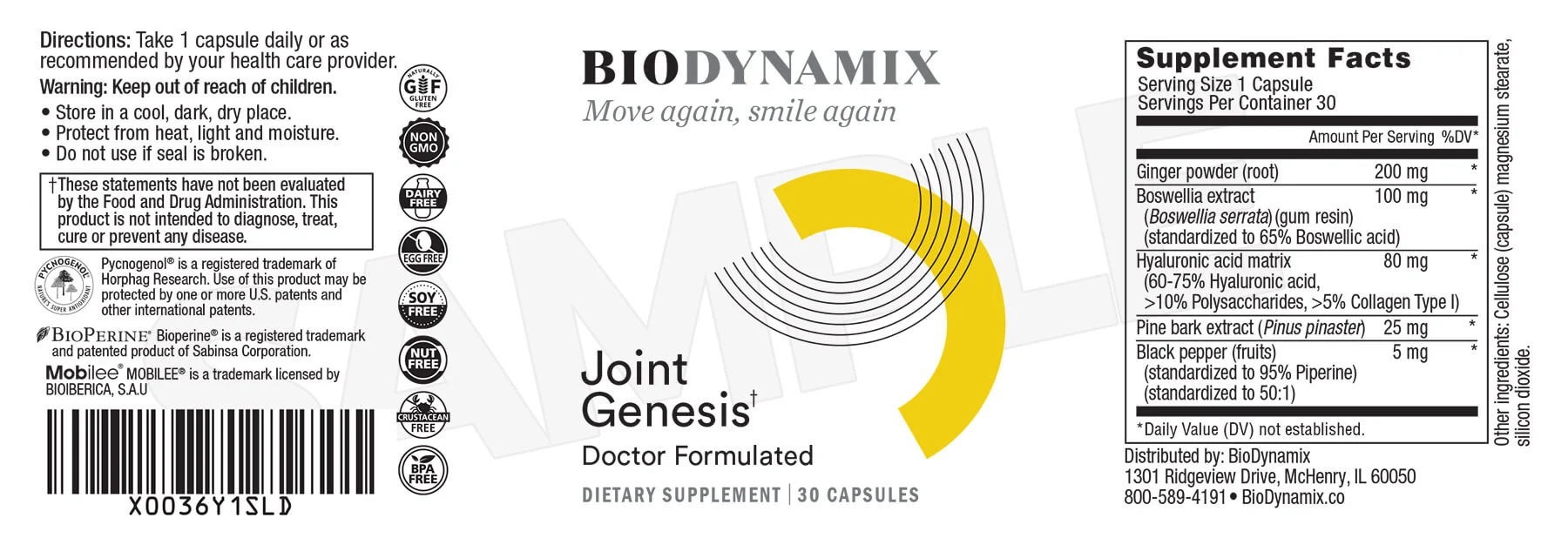
The supplied Supplement Facts label is the primary product reference for this page. It shows one capsule per serving and 30 servings per container. These are transcribed label facts; we have not independently tested the contents or authenticated a production lot. Compare them with the bottle you receive.
| Label ingredient | Per capsule | How to interpret it |
|---|---|---|
| Ginger powder (root) | 200 mg | Powder is not interchangeable with a concentrated extract. |
| Boswellia serrata gum-resin extract | 100 mg | 65% boswellic acid on the supplied label. |
| Hyaluronic acid matrix | 80 mg | 60–75% hyaluronic acid; also polysaccharides and type I collagen. |
| Pine bark extract (Pinus pinaster) | 25 mg | The label references the Pycnogenol trademark. |
| Black pepper fruit | 5 mg | 95% piperine and a 50:1 standardization are listed. |
Explore this review
The label, not just the marketing list80 mg matrix does not mean 80 mg pure HAStandardization: useful but not a shortcutOther ingredients and dietary preferencesIngredient research libraryA sourcing question the marketing does not settleSources used on this page80 mg matrix does not mean 80 mg pure HA
The matrix is labeled 60–75% hyaluronic acid, more than 10% polysaccharides and more than 5% type I collagen. Applying the stated HA range to 80 mg gives an estimated 48–60 mg of hyaluronic acid per capsule. This is arithmetic from the supplied specification, not a laboratory measurement.
The remaining matrix components matter when comparing it with a single-ingredient hyaluronic acid capsule. Two products with “80 mg” printed on different ingredient descriptions may contain different amounts and preparations. A study of a matrix also cannot automatically be treated as a study of isolated HA.
Standardization: useful but not a shortcut
The boswellia entry states 65% boswellic acid. Multiplying that percentage by 100 mg gives 65 mg of the listed standardized component. It does not tell you the quantity of every individual boswellic acid or establish equivalence with a trial using another standardized extract.
The black pepper entry states 95% piperine and 50:1. The percentage corresponds to 4.75 mg piperine if applied to the stated 5 mg entry. These numbers describe an ingredient specification; they are not a recommendation to increase the capsule count.
The ginger line says powder. Treating it as a strong standardized extract would overstate what the provided label says.
Other ingredients and dietary preferences
Cellulose for the capsule, magnesium stearate and silicon dioxide appear in the other-ingredients list. The supplied label also displays several free-from badges. We report the image rather than independently certifying those claims.
A cellulose capsule is not sufficient evidence of a vegan finished product. The matrix includes type I collagen, so ask the manufacturer about its origin if animal sourcing matters to you. For an allergy decision, obtain the current full allergen statement and manufacturing information; a promotional badge alone is not a complete assessment.
Ingredient research library
Ginger powder · Boswellia standardization · Hyaluronic acid matrix · Pine bark · Black pepper and piperine
A sourcing question the marketing does not settle
The brand shop describes the formula as vegan-friendly, while the supplied panel lists type I collagen in its matrix. We cannot resolve that from a marketing statement and this image alone. Request a current label and explicit ingredient-origin confirmation before making a dietary or allergy decision.